Crushing or disintegration of bladder stone(s) using telescopic instruments or laser with removal of the fragments via the telescope.
Alternatives to this procedure include:
- Open surgery if the stone is too large to remove via telescopic technique.
- Observation.
You will usually be admitted on the same day as your surgery.
You will be asked not to eat and drink for six hours before surgery. Immediately before the operation, the anaesthetist may give you a pre-medication, which will make you dry-mouthed and pleasantly sleepy.
Either a full general anaesthetic (where you will be asleep) or a spinal anaesthetic (where you are unable to feel anything from the waist down) will be used. All methods minimise pain. Your anaesthetist will explain the pros and cons of each type of anaesthetic to you. You will usually be given injectable antibiotics before the procedure, after checking for any allergies.
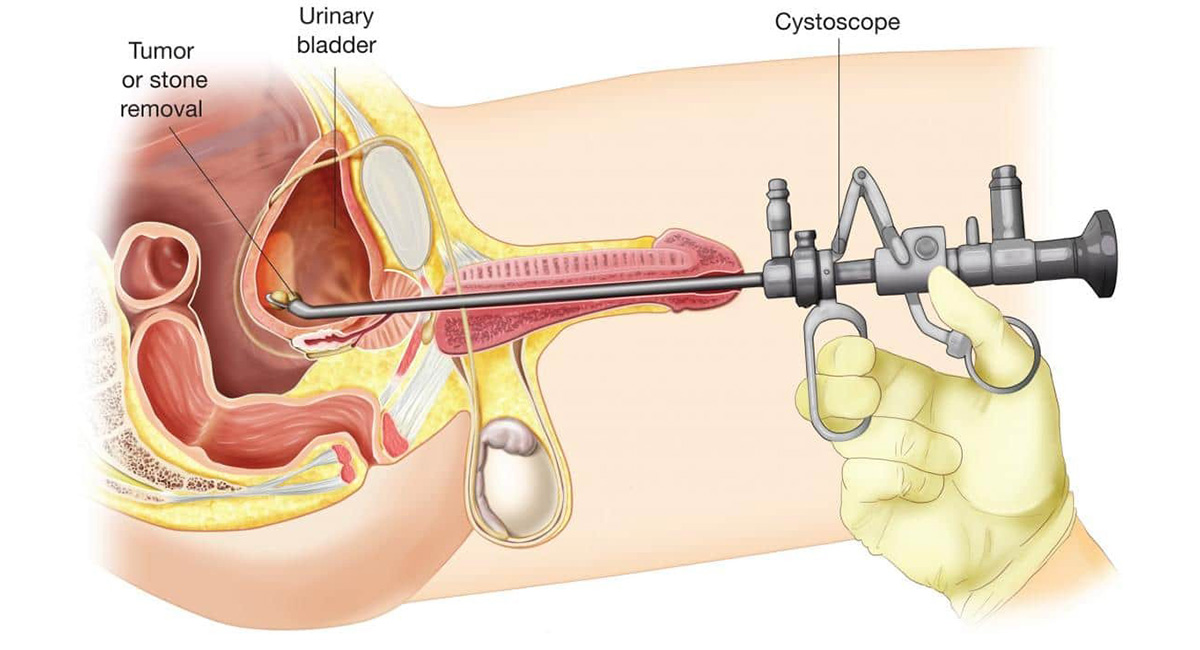
A special telescope is inserted into the bladder up the urethra (water pipe) to see the stones. These are then broken up using a crushing instrument (pictured), a mechanical disintegration probe or a laser. The stone fragments are removed from the bladder and a catheter inserted.
The catheter will be removed within 24 - 48 hours; following this, you will be able to pass urine normally. Some burning, frequency of urination and bleeding are common within the first 24 - 48 hours after catheter removal. It is not unusual for a plain X-ray of your abdomen to be performed on the day after surgery to confirm that all the stone fragments have been removed. The average hospital stay is five days.
All procedures have the potential for side effects. Although these complications are well recognised, the majority of patients do not have problems after a procedure.
There are specific risks with this surgical procedure, and these will be discussed with you before your procedure. As a guide to complement that one-on-one discussion with your surgeon, these include:
- Mild burning or bleeding on passing urine for short period after operation.
- Temporary insertion of a catheter.
- Need for an additional procedure (e.g. resection of the prostate gland) if this is thought to be the cause of the stone formation.
- Infection of bladder requiring antibiotics.
- Permission for telescopic removal / biopsy of bladder abnormality / stone if found.
- Recurrence of stones or residual stone fragments.
- Delayed bleeding requiring removal of clots or further surgery.
- Injury to the urethra causing delayed scar formation.
- Very rarely, perforation of the bladder requiring a temporary urinary catheter or return to theatre for open surgical repair.
When you get home, you should drink twice as much fluid as you would normally for the next 24 - 48 hours to flush your system through. When you first pass urine, you may find that it burns and it may be lightly bloodstained.
If you develop a fever, severe pain on passing urine, inability to pass urine or worsening bleeding, you should contact your Surgeon or GP immediately.
This information is intended as a general educational guide and may not apply to your situation. You must not rely on this information as an alternative to consultation with your urologist or other health professional.
Not all potential complications are listed, and you must talk to your urologist about the complications specific to your situation.
© 2025 Om Kidney Hospital. All Rights Reserved. Designed & Developed By: Desiration Hub.

 Appointment